Short answer
A breaker trips to protect your wiring. Occasional trips are normal; repeated or instant trips signal a fault — have a licensed electrician diagnose it.
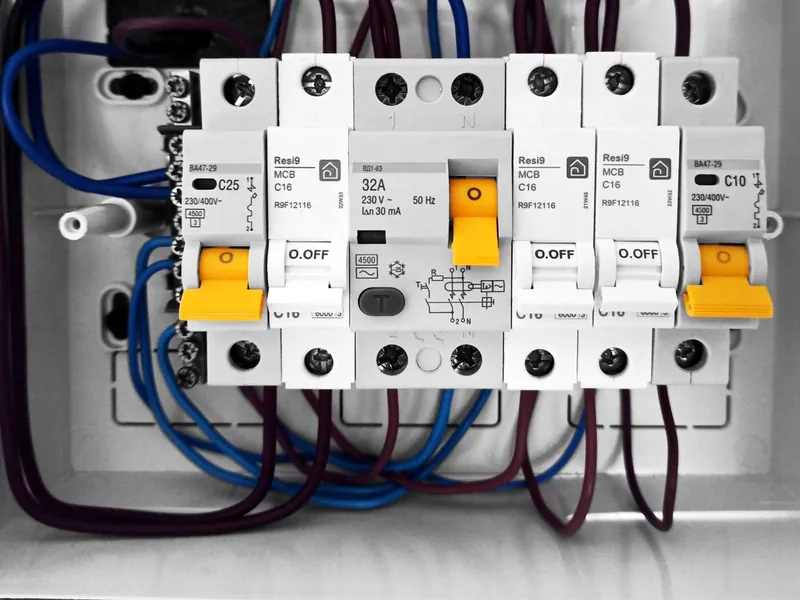
What a tripping breaker is telling you
A circuit breaker has one job: cut power before an electrical fault can overheat your wiring and start a fire. When it trips, it is doing its job — the question is whether it is reacting to a one-time overload or to a genuine fault in the circuit.
An occasional trip when you run the microwave, toaster, and coffee maker on the same kitchen circuit is annoying but normal: you simply asked the circuit for more current than it is rated to carry. The pattern that deserves attention is a breaker that trips repeatedly, trips for no obvious reason, or trips instantly the moment you reset it.
The most common causes
Overloads are the most common cause — too many high-draw devices on one circuit. Kitchens, home offices with space heaters, and garages with power tools are classic overload territory. If the trip happens when a specific combination of devices runs, overload is the prime suspect.
Short circuits are more serious: a hot wire touching a neutral or ground wire creates a surge of current, and the breaker trips instantly. You may notice a burning smell, a pop, or a flash at an outlet or switch. Ground faults — current leaking to ground, often through moisture — trip GFCI-protected breakers and outlets. Finally, breakers themselves wear out: an aging breaker can trip at loads well below its rating, especially in older panels.
- Overload: too many devices drawing on one circuit.
- Short circuit: hot wire contacting neutral or ground — trips instantly.
- Ground fault: current leaking to ground, often via moisture.
- Worn breaker: old breakers can trip below their rated load.
- Arc fault: damaged wiring arcing inside walls — AFCI breakers catch this.
What you can safely do
You can reset a tripped breaker yourself, but do it the safe way: first unplug or switch off everything on that circuit, then stand to the side of the panel (not directly in front of it), and flip the breaker fully to OFF before switching it back to ON. A breaker in the middle 'tripped' position must go fully off first.
Reset it once. If it holds and the circuit works normally, note what you had plugged in and avoid running it all at once. If it trips again — especially immediately — stop resetting it. Repeatedly forcing a breaker back on against a fault can overheat wiring and turn a small problem into a fire.
- Unplug devices on the circuit before resetting.
- Stand to the side of the panel, flip fully OFF then ON.
- Reset once — if it trips again, leave it off.
- Never tape a breaker in the ON position or swap in a larger breaker.
- Move heavy loads (space heaters, window ACs) to different circuits.
What an electrician checks
A licensed electrician starts by measuring the actual load on the circuit and comparing it to the breaker's rating, then works through the wiring: checking outlets and switches for loose connections, scorched terminals, or damaged insulation, and testing the breaker itself for proper trip behavior.
If the cause is chronic overloading, the fix may be splitting the load across circuits or adding a dedicated circuit for a heavy appliance. If the cause is damaged wiring, the damaged section gets repaired or replaced. An electrician can also tell whether your panel and breakers are simply aging out — which connects directly to knowing the signs you need a panel upgrade.
When to call an electrician right away
Some breaker symptoms should never wait for a convenient appointment. If you smell burning plastic or fish-like odors near the panel or outlets, see scorch marks or melted plastic, feel heat on the panel cover or outlet faces, or hear buzzing or crackling from the panel, stop using that circuit and call a licensed electrician promptly.
A breaker that trips the instant you reset it, or a panel with rust, water stains, or corrosion, also warrants prompt professional attention — water and electricity are a dangerous combination. If you ever see sparking or smell smoke, treat it as an emergency: turn off the main breaker if you can do so safely and call for help.